By Abi | Home Star Tuition | Writing tuition for ambitious children from international families
I have been working with a bilingual child for the past few weeks, and I wanted to share something of his progress – because it has been a genuine joy to witness.
When we started, he was struggling to write a single sentence. And when you understand what writing actually demands of a child, that is not at all surprising. Writing is not one skill. It is many things happening at once: holding an idea in mind, finding the words for it, organising those words into a sentence, managing grammar and spelling and punctuation, and then physically getting it down on the page.
For a bilingual child, there is an additional layer to all of this. The brain is navigating between languages, translating thought, and finding its way to expression in a language that may not yet feel entirely natural.
So rather than beginning with writing, we began with talking.
Why Bilingual Children Find Writing Particularly Challenging
It is worth pausing on this, because many parents – and some teachers – assume that a child who can speak confidently in a language should be able to write in it too. This is not always the case, and the gap between spoken fluency and written fluency is one of the most common sources of frustration I see in the children who come to me from international families.
When a bilingual child sits down to write, they are not simply doing what a monolingual child does, just in a second language. They are managing a fundamentally different cognitive process. The brain is holding two linguistic systems simultaneously – reaching for vocabulary in one, checking grammar against the rules of another, and all the while trying to organise ideas that may have formed in the language they think in most naturally.
This is not a learning difficulty. It is not a sign that a child is behind. It is a sign that their brain is working very hard indeed.
What this child – like so many bilingual learners – needed was not more writing practice. He needed a different starting point altogether.
Starting Where Language Actually Lives: Talk for Writing
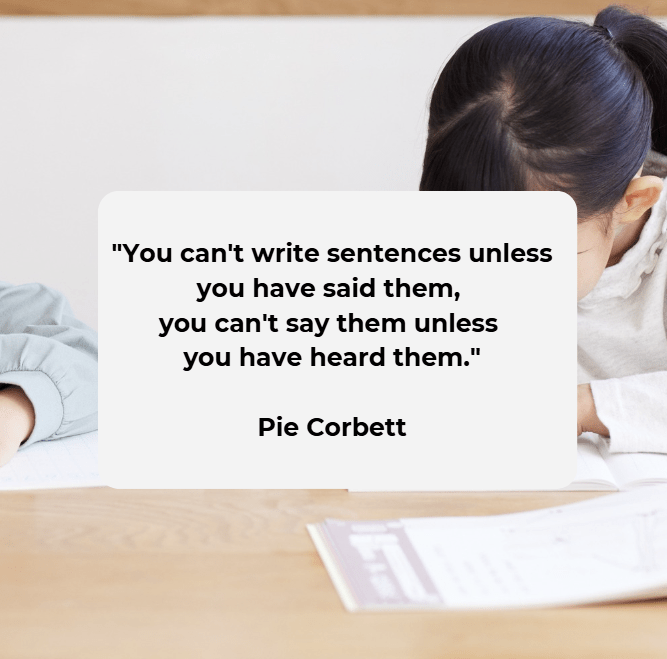
This draws on something I have long believed in, rooted in Pie Corbett’s Talk for Writing approach. The principle is simple but profound: children need to be able to say something before they can write it. If the language is not there orally, it will not appear on the page.
So we worked from a Think, Say, Write model:
- Think: We explored ideas together – through questions, images, and conversation. What does he notice? What does he remember? What does he want to say?
- Say: We built sentences out loud. He spoke them. I listened. We shaped them together until they sounded right to him – until they felt like his words.
- Write: Only then did we commit anything to paper.
That last step – putting it on the page – became almost effortless, because the hard work had already been done. The sentence existed. It just needed writing down.
This is not a shortcut. It is, in fact, how skilled writers work. They think before they write. They find the words in their head – or out loud – before they fix them on the page. For bilingual children, making this process explicit and supported can be genuinely transformative.
What Progress Actually Looks Like
Within a few sessions, something shifted. He stopped staring at the blank page. He stopped waiting to be told what to write. He began arriving at lessons with ideas – things he had noticed during the week, things he wanted to describe.
His sentences became longer. Then more varied. Then, gradually, more vivid. There was a moment – and I remember it clearly – when he wrote a sentence that surprised us both. It was not just correct. It was good. It had an image in it, a specific detail, a genuine voice.
He looked at it. Then he looked at me. And he smiled.
That is the moment I work towards with every child I teach.
The Advantage Bilingual Learners Bring
I want to say something important here, because it matters and it is not said often enough.
Bilingual and multilingual children are not at a disadvantage as writers. They are, in many ways, at a profound advantage – one that simply needs the right conditions to reveal itself.
A child who moves between languages has a heightened sensitivity to words. They notice shades of meaning, the texture of language, the way that different words carry different weight. They are, often without realising it, thinking about language more consciously than their monolingual peers. That awareness – that metalinguistic instinct – is one of the most powerful tools a writer can have.
What these children need is not remediation. They do not need to be fixed. They need a tutor who understands the specific demands their bilingualism places on the writing process, and who teaches in a way that works with those demands rather than against them.
They need space to think in whatever language feels most natural, before being asked to write in English. They need permission to speak before they write. They need to know that their linguistic background is not a barrier – it is a richness.
How I Work with Bilingual Children
My lessons are tailored specifically to the child in front of me. For bilingual learners, this typically means:
Building oral confidence first. We talk. We discuss. We try out sentences. Nothing goes on paper until it has been said aloud and feels right.
Separating the skills. Rather than asking a child to manage ideas, vocabulary, grammar, and handwriting all at once, we work on each element with care. Ideas come first. Structure comes next. The finer points of punctuation and grammar are woven in once the words are already there.
Celebrating what they bring. A bilingual child’s instinct for language – the way they move between registers, notice nuance, choose words with care – is something I name and celebrate in every lesson. Writing confidence grows from a child feeling capable, not corrected.
Connecting academic and creative writing. In my lessons, both are equally valued. A child who can write an imaginative description of a thunderstorm is building exactly the skills they will need for a persuasive essay or a structured analytical response. The two are not separate. They feed each other.
A Note for Parents
If your child is bilingual and struggling with writing – in English, or in any language – please know that this is not unusual, and it is not permanent.
The struggle often comes not from a lack of intelligence or ability, but from being asked to manage too many things at once without the right support. With the right approach, the words come. They always do.
I work online via Zoom with children aged 7 to 14 from international families around the world – in China, Hong Kong, Dubai, Singapore, Australia, and beyond. If you would like to talk about how I might be able to support your child, I would be very glad to hear from you.
Book a consultation at calendly.com/homestartuition

 Academic Writing Tutor | International Families
Leave a comment